
.svg)
Winter Storm Impact on Cannabis Dispensary Sales | January 2026
The Data
We analyzed sales data from 1,251 dispensary locations across nine states in the storm’s path: New York, New Jersey, Massachusetts, Connecticut, Maryland, Ohio, Michigan, Illinois, and Missouri.
Here’s what we found:
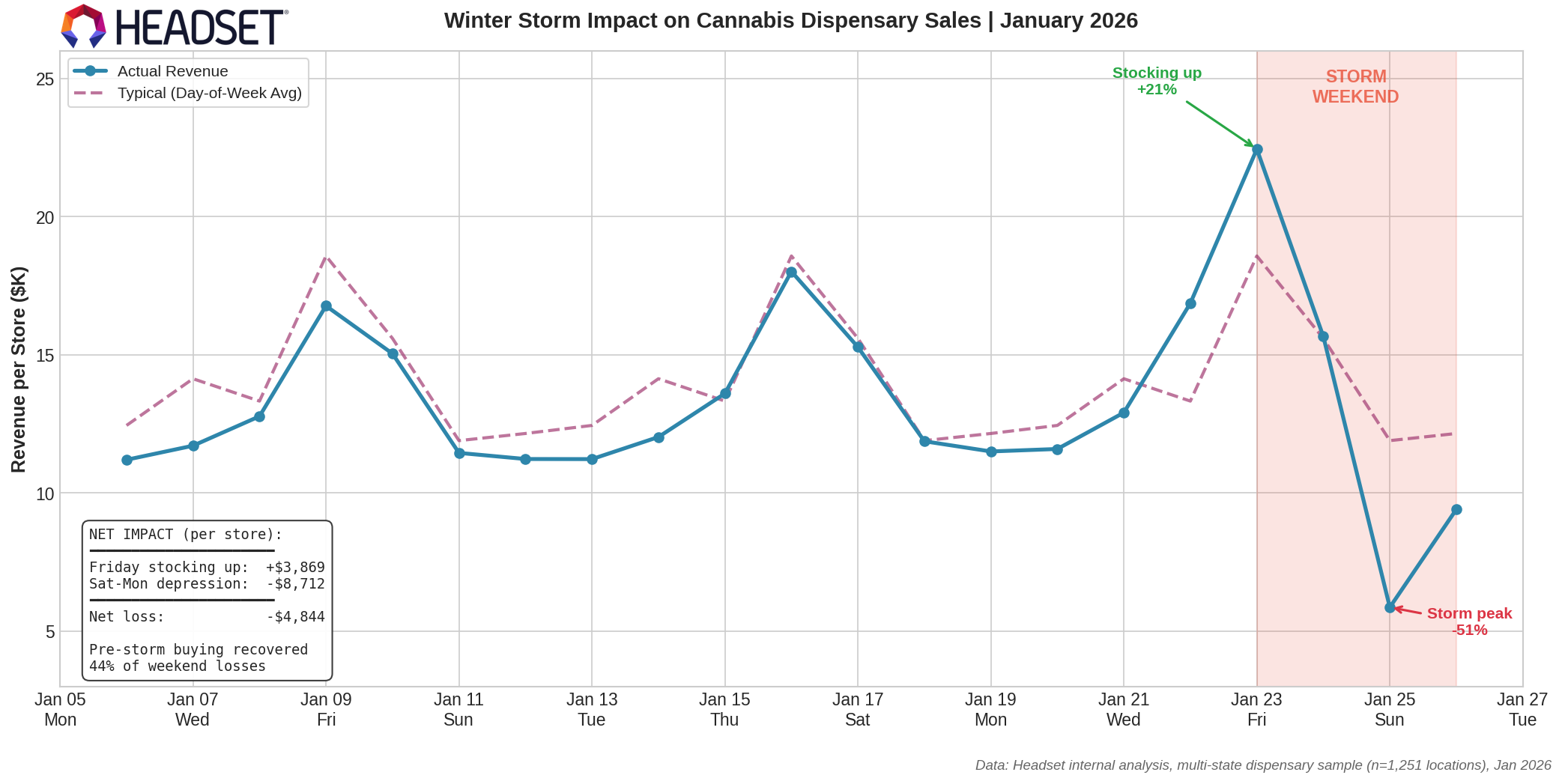
Friday, January 23 (pre-storm): Revenue jumped 21% above normal as customers stocked up ahead of the weather.
Sunday, January 25 (storm peak): Revenue cratered 51% below normal — the worst single day in our 120-day dataset.
Line chart showing cannabis dispensary revenue per store from January 6-27, 2026. The chart shows a typical weekly pattern with Friday peaks, until the storm weekend of January 23-26 when Friday spiked 21% above normal due to pre-storm stocking up, followed by a dramatic 51% drop on Sunday during the storm peak.
The Net Impact
Per store, the four-day storm period (Friday through Monday) looked like this:
- Friday stocking-up boost: +$3,869
- Saturday-Monday depression: -$8,712
- Net loss: -$4,844 per store
The pre-storm “stocking up” effect recovered 44% of the weekend losses. The other 56% was true lost revenue — not shifted demand, just gone.
But Here’s Where It Gets Interesting: The Regional Story
When we broke down the data by state, a fascinating pattern emerged. Storm severity mattered, but timing was everything.
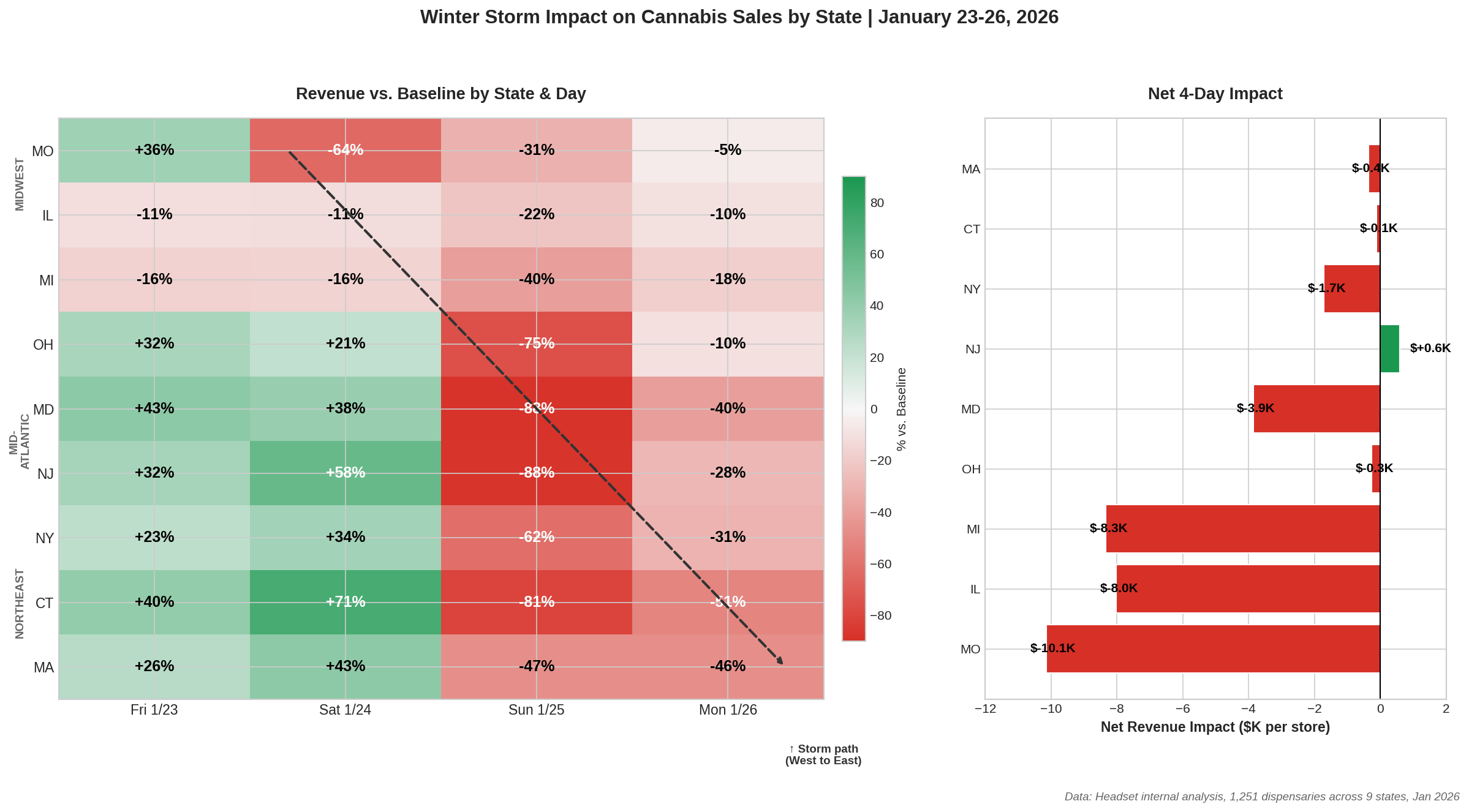
Heatmap showing revenue vs. baseline by state and day during the January 2026 winter storm. States are ordered from Midwest (top) to Northeast (bottom), showing the storm’s path. Green cells indicate above-normal revenue, red cells indicate below-normal. Missouri shows Saturday as worst day (-64%), while Northeast states show Sunday as worst (-62% to -88%). Adjacent bar chart shows net 4-day impact ranging from -$10.1K (Missouri) to +$0.6K (New Jersey).
You can literally trace the storm’s path from west to east across our data:
Missouri got hit first — Saturday was their worst day (-64%), while the rest of the country was still stocking up. They had the worst net impact of any state: -$10.1K per store.
The Northeast states (NJ, MD, CT) saw the most dramatic single-day crashes on Sunday (-88% in New Jersey and Maryland), but they also had the strongest pre-storm stocking behavior (+40-70% on Friday and Saturday).
The surprising finding: The worst single-day drops didn’t equal the worst net impact.
Net 4-Day Impact by State (ranked worst to best):
Missouri: -$10.1K — Worst day was Saturday (-64%)
Michigan: -$8.3K — Worst day was Sunday (-40%)
Illinois: -$8.0K — Worst day was Sunday (-22%)
Maryland: -$3.9K — Worst day was Sunday (-88%)
New York: -$1.7K — Worst day was Sunday (-62%)
Massachusetts: -$0.4K — Worst day was Sunday (-47%)
Ohio: -$0.3K — Worst day was Sunday (-75%)
Connecticut: -$0.1K — Worst day was Sunday (-81%)
New Jersey: +$0.6K — Worst day was Sunday (-88%)
Yes, you read that right — New Jersey actually came out ahead despite an 88% crash on Sunday. Their massive Friday (+32%) and Saturday (+58%) stocking-up surge more than offset the weekend collapse.
Why the Midwest Fared Worse
The Midwest states (Missouri, Michigan, Illinois) had the worst net impact despite less dramatic single-day drops. Why?
- The storm arrived sooner — less warning meant less time for customers to stock up
- Friday was a normal or below-normal sales day — no pre-storm surge
- Recovery started while the Northeast was still shut down — but the damage was already done
The Takeaway
For cannabis retailers, this analysis reveals two key insights:
1. Pre-storm communication matters. States with 24-48 hours of warning saw customers shift purchases forward. States caught off-guard just lost the sales outright. Consider proactive messaging when severe weather is forecasted.
2. It’s not about how bad the worst day is — it’s about capturing the demand surge. New Jersey’s Sunday was just as brutal as Maryland’s, but their net outcome was completely different because they maximized the stocking-up window.
Weather events are still net-negative for cannabis retail in most cases. But the degree of that impact is far more controllable than you might think.